
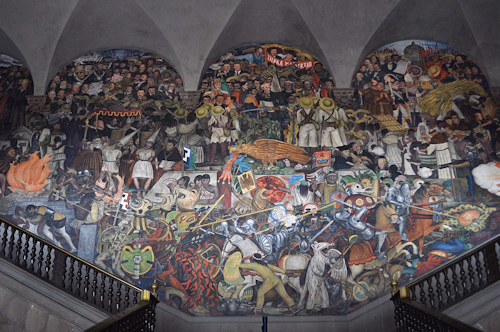
Mexico is known for its folk art traditions, mostly derived from the indigenous and Spanish crafts. Pre-Columbian art thrived over a wide timescale, from 1800 BC to AD 1500. Certain artistic characteristics were repeated throughout the region, namely a preference for angular, linear patterns, and three-dimensional ceramics.Mural by Diego Rivera at the National Palace depicting the history of Mexico from the Conquest to early 20th century.
.jpg)
Notable handicrafts include clay pottery from the valley of Oaxaca and the village of Tonala. Colorfully embroidered cotton garments, cotton or wool shawls and outer garments, and colorful baskets and rugs are seen everywhere. Mexico is also known for its pre-Columbian architecture, especially for public, ceremonial and urban monumental buildings and structures.
Following the conquest, the first artistic efforts were directed at evangelization and the related task of building churches. The Spanish initially co-opted many indigenous stonemasons and sculptors to build churches, monuments and other religious art, such as altars. The prevailing style during this era was Baroque. In the period from independence to the early 20th century, Mexican fine arts continued to be largely influenced by European traditions.
After the Mexican Revolution, a new generation of Mexican artists led a vibrant national movement that incorporated political, historic and folk themes in their work. The painters Diego Rivera, José Clemente Orozco, and David Siqueiros were the main propagators of Mexican muralism. Their grand murals often displayed on public buildings, promoted social ideals. Rufino Tamayo and Frida Kahlo produced more personal works with abstract elements. Mexican art photography was largely fostered by the work of Manuel Álvarez Bravo.[11]
